

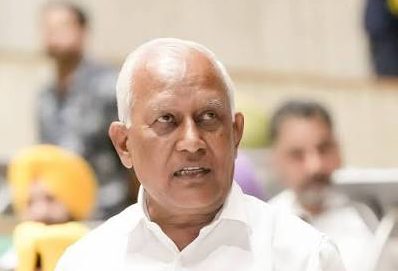
MANN GOVT TAKES CANAL WATER TO TAIL-END FIELDS, SAND DUNES AND EVEN HILLY AREAS: BARINDER KUMAR GOYAL
19,316 WATERCOURSES RESTORED; CANAL WATER REACHES 1,687 LOCATIONS FOR THE FIRST TIME
CANAL IRRIGATION EXPANSION HELPS IMPROVE GROUNDWATER STATUS IN 48% OF ASSESSMENT BLOCKS
PUNJAB VIDHAN SABHA UNANIMOUSLY PASSES RESOLUTION TO LAUD EFFORTS OF MANN GOVERNMENT FOR RESTORATION OF CANALS AND WATERCOURSES
Chandigarh, August 10 (WISHAVWARTA);- Punjab Water Resources and Soil and Water Conservation Minister Sh. Barinder Kumar Goyal today asserted that Chief Minister S. Bhagwant Singh Mann-led Punjab Government has transformed the state’s irrigation landscape by restoring canals and watercourses and ensuring that canal water reaches even the tail-end fields, sand dunes and elevated hilly areas.
Speaking in the Punjab Vidhan Sabha on the resolution moved by MLA S. Davinderjit Singh Laadi Dhos to laud the efforts of the Punjab Government for restoration of canals and watercourses, the Water Resources Minister said that the Mann government had undertaken these works with the larger objective of conserving Punjab’s precious groundwater and securing the future of agriculture in the state. The resolution was passed unanimously in the Punjab Vidhan Sabha.
While speaking on the resolution, Sh. Barinder Kumar Goyal said Punjab had made an unparalleled contribution to the country’s food security by extensively using its groundwater resources for agriculture. However, the prolonged dependence on groundwater had placed the state’s water resources under severe stress. He said the Mann government recognised the gravity of the situation and adopted a clear strategy to shift agricultural dependence towards canal irrigation by taking canal water to fields across Punjab.
The Cabinet Minister said that strengthening the canal network and restoring watercourses were essential for ensuring reliable irrigation to farmers. He said a major hurdle under the earlier system was the requirement for farmers to contribute 10% of the cost of watercourses and underground pipelines while 90% was borne by the government. Since many farmers were unable to contribute their share, several projects remained stalled.
Sh. Goyal said that in the year 2023 the Mann government took a decisive step by waiving the 10% contribution of farmers and undertaking to bear the entire cost of such works. This decision removed a major financial obstacle and accelerated the restoration of watercourses and laying of underground pipelines across the state.
The Water Resources Minister said that as part of this concerted drive, around 19,316 watercourses have been restored across Punjab. He said several watercourses had virtually disappeared from the ground despite continuing to exist on official records. The government restored these channels with the cooperation of local residents and made the canal irrigation network functional in areas that had remained deprived of canal water for years.
Giving the example of Sarhali Distributary, Sh. Barinder Kumar Goyal said that a nearly six-kilometre-long minor which was buried underground and had virtually disappeared from the ground was restored by the department. He said the restored minor was now supplying water to villages including Naorangabad, Kairo, Baniwala, Jamalpur, Mianwind, Asal Uttar, Bhore Kona, Sarhali and Nushahra Pannuan and providing irrigation to around 4,737 acres.
Sh. Goyal said that the government had also significantly enhanced the carrying capacity of existing canals including the Sirhind Feeder and Ferozepur Feeder. Instead of relying solely on construction of new canals, the department increased the capacity of the existing network through widening and deepening of canal sections.
He said the capacity of the state’s canal system had now risen to around 36,000 cusecs and the water flow had touched nearly 39,000 cusecs. He said the canal network was now carrying water close to its full supply level in several stretches thereby ensuring improved availability of irrigation water.
The Cabinet Minister said that 1,687 locations across Punjab had received canal water for the first time. He said he had personally visited around 45 Assembly constituencies where canal water had reached areas that had earlier remained deprived of this facility.
He said the arrival of canal water had brought immense relief and joy to farmers and villagers. In several areas people celebrated by beating drums and performing bhangra while in some places villagers even entered the newly supplied water channels to express their happiness.
Sh. Goyal said the Mann government had also ensured that difficult terrain was not left out of the irrigation network. Through a lift irrigation scheme in Kathgarh, a project costing Rs.135 crore was executed to lift water to areas situated around 70 feet above the surrounding level and provide irrigation to around 11,737 acres.
Highlighting the work undertaken in the Qadian area, the Cabinet Minister said the Riarki Distributary was strengthened at a cost of Rs.30.50 crore. Its capacity was increased from 216 cusecs to 385 cusecs and around 5.5 kilometres of concrete lining was undertaken.
He said the project had extended irrigation benefits to around 43,000 acres. Representatives from around 30 villages had expressed their appreciation after canal water reached their fields for the first time.
Sh. Goyal said the restoration of canal infrastructure was already producing encouraging results in terms of groundwater conservation. Referring to the Central Ground Water Board report, he said that out of 153 groundwater assessment blocks in Punjab, 74 blocks, accounting for around 48%, had shown improvement in their groundwater status.
He said five blocks had also moved from higher groundwater stress categories towards relatively better categories. These findings provided encouraging evidence that expanding canal irrigation and reducing dependence on groundwater extraction could help improve the state’s groundwater position.
Responding to the issue of water sharing, Sh. Goyal said Punjab had historically made enormous sacrifices for the country’s food security and had a legitimate responsibility to safeguard its water resources. He said the state would not part with water beyond its rightful share.
At the same time, he said, Punjab had displayed its humanitarian spirit by responding to Haryana’s request for water during an urgent situation. He said Haryana had sought 4,000 cusecs of water citing requirements for drinking water, livestock and thermal power plants and Punjab had provided the water from its own share.
The Cabinet Minister said the Mann government had not merely spoken about water conservation but had created the infrastructure required to make canal irrigation accessible to farmers. He said the restoration of canals and watercourses along with underground pipelines and concrete lining had created a stronger irrigation network across the state.
Sh. Goyal urged people of Punjab to use water judiciously and avoid wastage. He said even saving a single glass of water today could contribute to securing the future of the coming generations.
He congratulated Chief Minister S. Bhagwant Singh Mann for taking up the challenging task of restoring canal irrigation and ensuring water reaches fields across Punjab. He said taking canal water to the tail ends, sand dunes and even elevated hilly areas was a significant step towards saving Punjab’s groundwater and protecting the state’s agricultural future.
Cabinet Minister Harjot Singh Bains and MLAs Lakhbir Singh Rai, Jagdeep Singh Kaka Brar, Narinderpal Singh Sawna, Manjinder Singh Lalpura, Manwinder Singh Giaspura and Naresh Kataria also shared their views on the resolution.